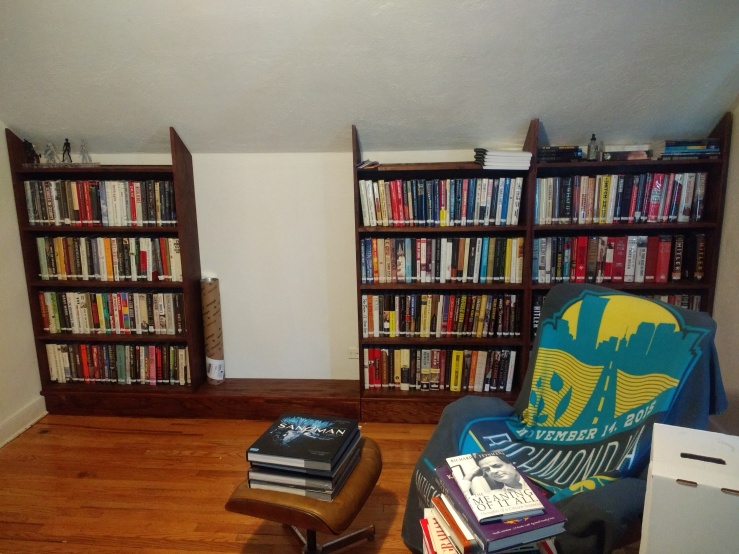
As part of moving to a new house I have the opportunity to (pending consultation with a structural engineer) actually shelve – rather than box – my entire library. Twenty-plus years of literary (and, well, some not-so-literary) acquisitions organized for the first time – the idea was thrilling. But it would require surmounting some serious practical difficulties.
(See the structural engineer mentioned above.)
According to LibraryThing’s wonderful stats page, my library at time of moving was roughly 4,377 volumes [‘roughly’ because it sometimes doesn’t fully capture multi-volume sets, pamphlets and magazines, etc.] weighing about 7,858 pounds and occupying (if they were to be somehow shelved) 725 linear feet. [Adding epsilon to account for my prolific use of post-it scrids.]
Obviously, my previous shelf-building strategies (to wit, building a case to fit whatever wall-space was available and then filling it up with whichever books were of an appropriate size; or piling up books of like size until I had a case’s worth and then building such a case) would be insufficient for this task.
A complication is that the library contains books of widely varying sizes. Lots of paperbacks, yes, and those are certainly straightforward to shelve, but also textbooks, square-format newspaper comic collections, textbooks, long-format comics collections (both large and small), graphic novels, trade paperbacks, hardcover books, etc. Given the number of bookcases I would be making, optimal usage of construction materials was also a consideration – textbook shelves would have to be constructed much more sturdily than paperback shelves; I wanted to avoid excess shelf depth for cost, weight, space, and dust-collection reasons; etc.
So I decided that this would be a good opportunity/excuse to try a ‘practical’ programming project – pull my LibraryThing collection info into a PostgreSQL database, scrub and format it, spit out the well-formed records to pass into an R script to run a K-means cluster analysis, plot the results as well as summary views before and after with GNUplot, pull it back into PostgreSQL to generate statistics for each cluster and add appropriate shelving tags to my LibraryThing database, and wrap as much as possible up in a bash script for simplicity’s sake.
(Before I began, I was well aware that after all of this I could very well end up with the classic “case for textbooks and tall books, two cases for trade paperbacks, the rest split between hardcovers and paperbacks” distribution, but in the first place it might very well not, and in the second, well, it’d be fun anyways.)
And…
Overkill is underrated.




 Don Norum