GORUCK Rifle Case / LaRue Covert Rifle Case

Note: You can’t actually buy the GORUCK Rifle Case at the moment (it’s been available through a pre-order, an initial run, and a second pre-order to date). It’s probably 50/50 if it becomes standard production this time around, and even then, outside of their core rucks GORUCK often comes and goes on inventory.

(Not that there’s anything wrong with this; it’s just a different mentality that you have to be willing to accept. GORUCK is a small, high-quality, American-made gear company; they don’t have a logistics tail of Chinese factories & warehouses [although, fine, I admit that I don’t know where their Cordura, thread, etc. comes from…] nor front-end resellers buying in bulk.

Up-front for what it’s worth, if the GORUCK case had been available when I bought the LaRue case, I would have ponied up the extra for the GORUCK case. I’m happy with the LaRue case, but I’m also a GORUCK aficionado.

Now that I have both, though, they’re similar enough and different enough that I’ve got a better understanding of both of them; enough to provide a bit more of an overview than “Yup, it’s a case, it holds a rifle.”

Further note that my point of view on this is that of an OCPD geek. If you want to improve your shooting, buy a case of cheap ammo and go practice. If you want to take a piece of gear downrange, buy a pallet and test it to destruction yourself.

If you’re bummed that Sortimo T-BOXXen still aren’t readily available stateside and really wish that we could all just get along and choose one of MIL-STD-1913 / KeyMod / M-LOK already, then yeah.=ƎE=)

Both cases are advertised / designed to either hold an assembled SBR or a broken-down carbine or rifle. (I’m using my go-to AAC 300 BLK 9″ and a Noveske Light Recce 16″ here.)

Continue reading “GORUCK Rifle Case / LaRue Covert Rifle Case”

Challenge: Accepted

I don’t run. At least, I didn’t run, apart from a few 5Ks here and there, the Charlottesville 10-Miler a couple of times because a bunch of people from morning workout were running in it, that sort of thing.

But, and this is important, I do stupid things. Admittedly, less “Of course I can chug that!” stupid and more “12 overnight hours and 20+ miles of cross-country log-carrying tactical-movement with a rucksack full of bricks? With another one the next afternoon? Why not!” stupid.

(In fairness, however, it was only a Challenge-Light, not a Challenge-Challenge or HCL. I may do stupid things, but I am not a moron.)

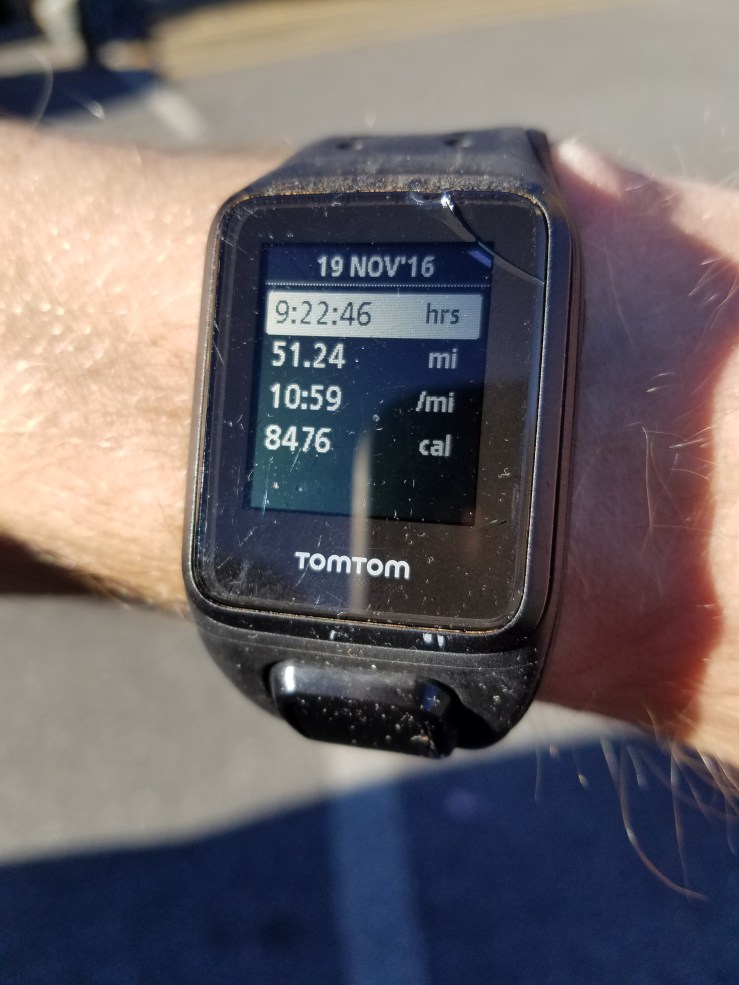
So I decided to run the Richmond Marathon last year on a whim. And I accepted my brother’s challenge that if I could get out of bed the next morning (loft bed with railings and a ladder, so trickier than just rolling to one side) I’d sign up for the Seashore State Park 50K that December.

Unfortunately, the 50K was full up by the time of the marathon. Darn. Still, with a rucksack full of food, water, and a pre-race outer layer that I was too stubborn and Norwegian-Lutheran to actually discard and so got stuffed in on top of the 3L hydration bladder, I finished.

(I had covered this distance before [more or less, and spread out over between the Challenge-Light…] and I was used to moving with a rucksack, to be fair.

[And I sweat… profusely, so dehydration was a concern for me.])

A while after that, some guy made the internet for running a half-marathon in a suit, and right after that the cofounder of Ministry of Supply ran a much faster half-marathon in one of their just-released Aviator 2 suits.

Continue reading “Challenge: Accepted”

A Brief Setback – Bookshelf Design, Part 2

LibraryThing is awesome. It’s pretty much the only way my library can possibly be in any sort of order and the database export is the starting point for the cluster analysis shelving project. On top of that it’s a great community of tech people with a love for books, real actual physical printed books, which is a rare and valuable quality in the world today.

Unfortunately, in the process of cataloging and double-checking books as I boxed them up to take over to the new house, I discovered that some of the auto-generated physical dimensions are out-of-order (swapping height and length, length and thickness, etc.) or wrong.

Which means that I am now ~1% done with verifying and/or entering the dimensions of the books piled throughout the first floor.

So…

download (1)

GitHub – Bookshelf Design, Part 1.5

And it has begun…

https://github.com/dnorum/cluster_analysis

Technically, as can be seen from the commit history, it began at the end of November last year. But with books piled knee-deep around pretty much the entire periphery of my first floor, it needs to begin to get serious.

It still needs a bit more refactoring and updating to go from being a personal project, i.e. a hideously messy set of ad-hoc scripts racing to stumble and flop across the finish line before they achieve a critical mass at which point any bug ‘fix’ introduces k>1 new bugs resulting in an event horizon from beyond which useful results can no longer escape, to a ‘real’ project with an actual useful README and notes and well-structured directories and all of that that you can be reasonably sure you can run without accidentally rm-rfing (remreffing? rm -fr and rimfiring, maybe?) yourself in the foot.

And then I need to actually finish it.

But it’s getting there.

Overkill is Underrated – Bookshelf Design, Part 1

As part of moving to a new house I have the opportunity to (pending consultation with a structural engineer) actually shelve – rather than box – my entire library. Twenty-plus years of literary (and, well, some not-so-literary) acquisitions organized for the first time – the idea was thrilling. But it would require surmounting some serious practical difficulties.

(See the structural engineer mentioned above.)

According to LibraryThing’s wonderful stats page, my library at time of moving was roughly 4,377 volumes [‘roughly’ because it sometimes doesn’t fully capture multi-volume sets, pamphlets and magazines, etc.] weighing about 7,858 pounds and occupying (if they were to be somehow shelved) 725 linear feet. [Adding epsilon to account for my prolific use of post-it scrids.]

Obviously, my previous shelf-building strategies (to wit, building a case to fit whatever wall-space was available and then filling it up with whichever books were of an appropriate size; or piling up books of like size until I had a case’s worth and then building such a case) would be insufficient for this task.

A complication is that the library contains books of widely varying sizes. Lots of paperbacks, yes, and those are certainly straightforward to shelve, but also textbooks, square-format newspaper comic collections, textbooks, long-format comics collections (both large and small), graphic novels, trade paperbacks, hardcover books, etc. Given the number of bookcases I would be making, optimal usage of construction materials was also a consideration – textbook shelves would have to be constructed much more sturdily than paperback shelves; I wanted to avoid excess shelf depth for cost, weight, space, and dust-collection reasons; etc.

So I decided that this would be a good opportunity/excuse to try a ‘practical’ programming project – pull my LibraryThing collection info into a PostgreSQL database, scrub and format it, spit out the well-formed records to pass into an R script to run a K-means cluster analysis, plot the results as well as summary views before and after with GNUplot, pull it back into PostgreSQL to generate statistics for each cluster and add appropriate shelving tags to my LibraryThing database, and wrap as much as possible up in a bash script for simplicity’s sake.

(Before I began, I was well aware that after all of this I could very well end up with the classic “case for textbooks and tall books, two cases for trade paperbacks, the rest split between hardcovers and paperbacks” distribution, but in the first place it might very well not, and in the second, well, it’d be fun anyways.)

And…

Overkill is underrated.

GORUCK FAD Handgun AAR

Update 2016-05-13: If you’re interested in GORUCK Firearms Gear and missed out on the latest pre-order, my brother’s put together a quick tutorial about upgrading a regular rucksack into a Shooter-style Ruck:

https://www.reddit.com/r/Goruck/comments/4ipyk9/homemade_ruckshooter_ruck_upgrade/

Note – I wrote this up for my own reference from my scrawled notes the week after the FAD, and then I went back and formatted and edited it to put up here years later. If anything ended up misremembered or flat-out wrong, that’s on me.

Introduction:

We started off ranked up and the cadre went over the basics – range rules, cold and hot, what the medevac vehicle was, all of the basics. Lots of jokings, (“We have several Delta medics here, but you’re all civilians, so if you’re injured, they’ll just sit and watch.” [Bert points and laughs.] “And remember, you signed a death waiver.” And, “We’ll throw you in the back of the car and drive you to the nearest hospital. Which is six hours away.”) but it was still all professional and squared away.

Then we all circled up around Tyler as he went over the basics. We all had to recite after him the Four Rules and he also clarified that, while the First Rule is that all guns are loaded, that said – know what condition your gun is in at all times. Then he went over the details of loading, unloading, manipulating, checking, and handling of the gun.

When you have your gun out of the holster, it makes us nervous. We might say, ‘No, don’t do that’, but inside we’re thinking ‘Holy fuck no, don’t fucking do that!’
– Cadre Garrett

Someone asked a question about the slide being locked back, and one of the guys in the advanced group said how there’s a notch on the slide that gets caught, and Garrett spoke up – “We’ve got half a dozen cadre here. If he [Tyler] misses anything, we’ll help him out.” Translation – shut the fuck up, guy. Adults are talking. Very calm and no-nonsense.

Throughout, Tyler stressed how shooting was a science. Math, physics, ballistics in between, all of it science. Do A, then B. How stance helps with balance, and how a lot of that is common sense (i.e., put someone on a moving platform and see how they naturally stand).

Continue reading “GORUCK FAD Handgun AAR”

GORUCK FAD Rifle 002 AAR

Update 2016-05-13: If you’re interested in GORUCK Firearms Gear and missed out on the latest pre-order, my brother’s put together a quick tutorial about upgrading a regular rucksack into a Shooter-style Ruck:

https://www.reddit.com/r/Goruck/comments/4ipyk9/homemade_ruckshooter_ruck_upgrade/

Note – I wrote this up for my own reference from my scrawled notes the week after the FAD. If anything ended up misremembered or flat-out wrong, that’s on me.

No idea how long it’ll be up, but the Facebook page with pictures and such is here.

Introduction:

We started off hanging out in the parking lot for a few minutes as people trickled in – lots of GORUCK gear in evidence, obviously, and mostly young to younger-middle-aged males. An interesting contrast to the mostly older men and women showing up in equal numbers for the handgun class being put on by the range the same morning.

Snow started falling fairly heavily and, as fun as it would have been to see the vortex trails from the full firing line, I’d foregone a base layer of tights and was just in jeans… Fortunately, it let up by the time we came back outside after the briefing.

The Cadre called everyone into the clubhouse and introduced themselves (there had been a brief delay due to three or four traffic stops by State Police on the way over). Cadre Machine was leading the course, with Cadres Jesse and Logan assisting.

Everyone confirmed their name, age, occupation, GORUCK experience, and firearms experience. As you might expect, mostly male, mostly young – thirty plus ten minus five, a preponderance of police / EMT / firefighters / forensics scientists, a few techies, and most had done several GORUCK events.

There were several, though, who hadn’t done any GORUCK events, and several who hadn’t fired a gun before. Only a couple had serious experience with the AR platform (besides the Cadre, of course), though most had some pistol and general firearms experience.

Standard uniform was Arc’teryx jacket and cargo pants, supplemented with sweatshirts and morale patches. Apart from a couple of guys with chest rigs or battle belts and one guy running drop-leg, the tacticool-aid was at a minimum.

Scene set, we drove over to the club’s law enforcement range and got out our kit, set our stuff up underneath the shelter, and then joined Cadre Machine in classroom formation out on the range.

Continue reading “GORUCK FAD Rifle 002 AAR”

GoRuck Team Weight

Each GoRuck challenge requires a team weight – 25# for the Challenge, 15# for the Light. Ideally awesome. For Light 002 with Cadre Devin, our weight was a lead-filled bulldog wearing a backpack filled with tiny, red-white-and-blue wrapped bricks. Time for a new team weight for the upcoming back-to-back Challenge-Light in Charlottesville.

Requirements:

1) Awesome.

2) Modular – able to be pared down for the Light without having to take a saw to it.

3) Portable – not just small enough to carry, but convenient to handle while buddy-carrying, crawling, running, etc. Also will need to be passed from person to person easily.

4) Awesome.

Solution:

Chest rig with magazines.
In addition to it costing a ton for the PMAGs and ammo, I don’t really want to carry around that much live ammo in a non-zombie scenario.

So – fill the magazines with lead.

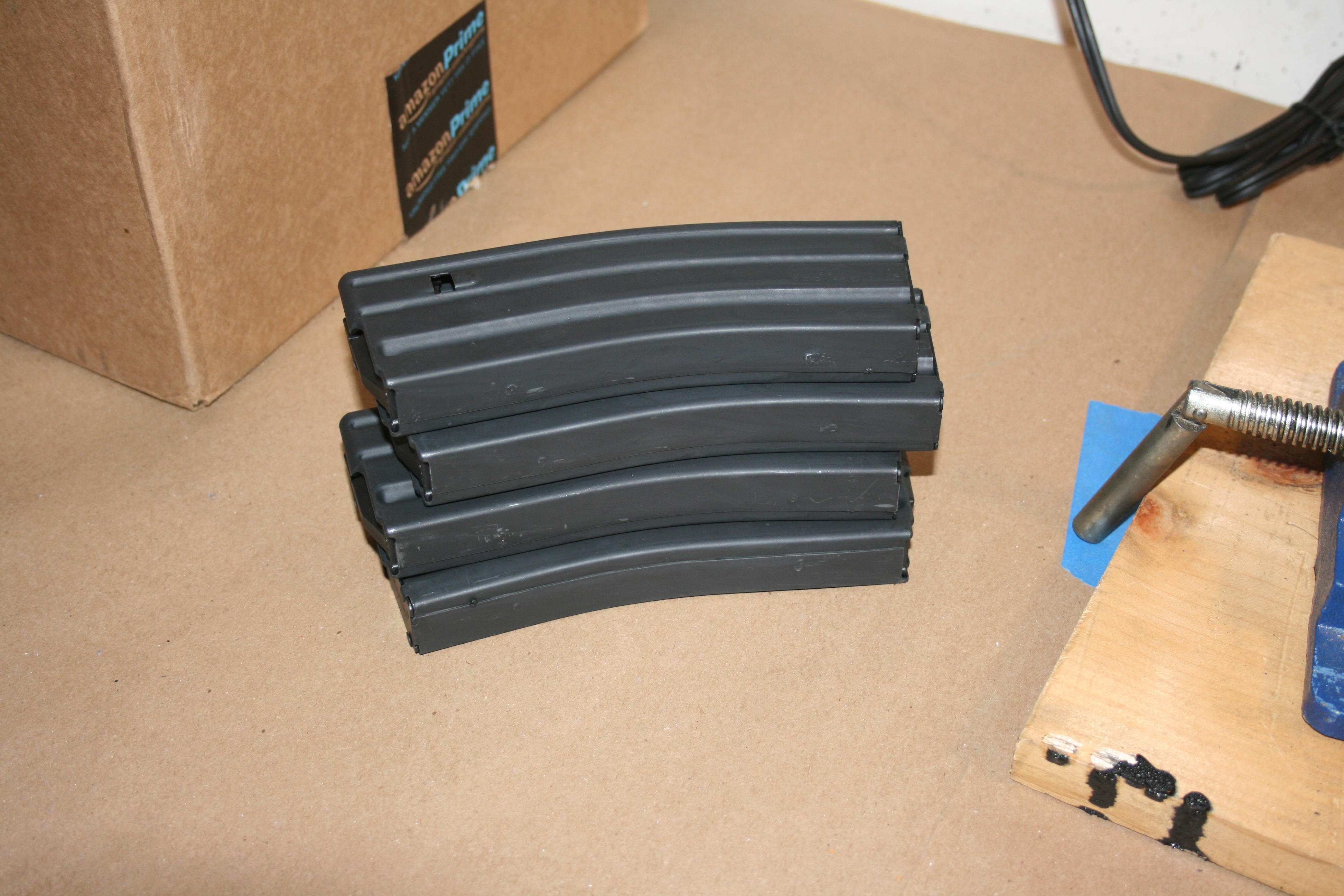
After carefully figuring out the internal volume of a STANAG 4179 30-round magazine, I didn’t do any of that and bought a stack of metal 30-round magazines. (The cheapest and worst-rated I could find.)

Stack of magazines.
Stack of magazines soon to be filled with lead. (One was already done as a test run.)

Now to fill them with lead. First, I stripped out the springs and followers.

Springs & Followers.
Springs and followers stripped out of magazines.

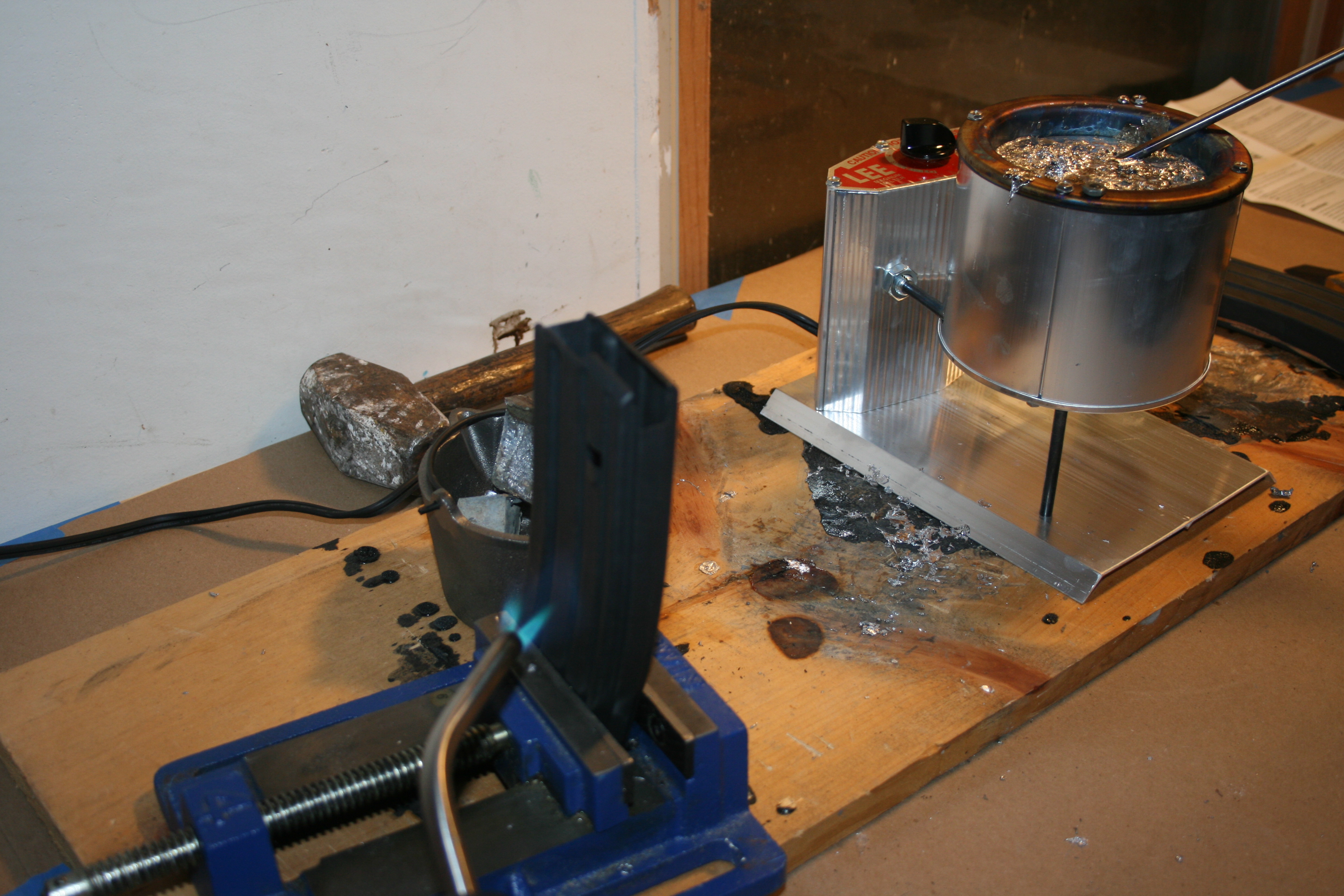
Then I melted some lead. Pieces of lead brick left over from previous weights went into the pot.

Workbench
Vise for holding magazines while pouring, melting pot with lead, pot with more lead, hammer, cold chisel, and dipper.

Holding the magazine in a bench vise, I hit it with a blowtorch to preheat the metal.

Preheating.
Preheating the magazines with a blowtorch. Also burns off some of the coating.

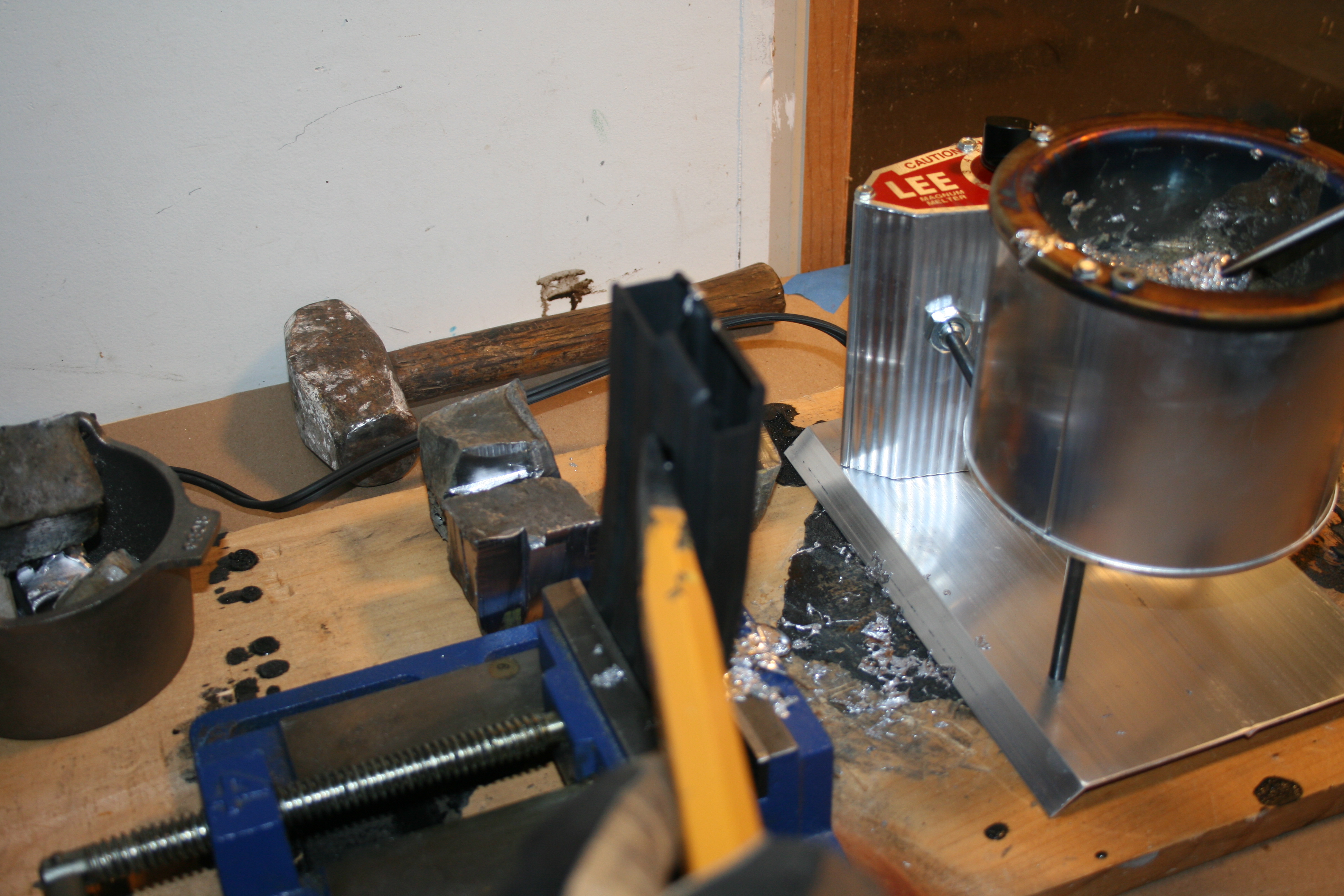
The magazines had holes in the base and for the magazine catch, so I held a flathead screwdriver against them as I poured that level. (The cold metal cooled the lead quickly enough to plug the holes. I still had some leaks, though, requiring re-melting and re-pouring.)

Mag Catch.
Covering the mag catch with a cold chisel. Still sprang a leak every now and then.

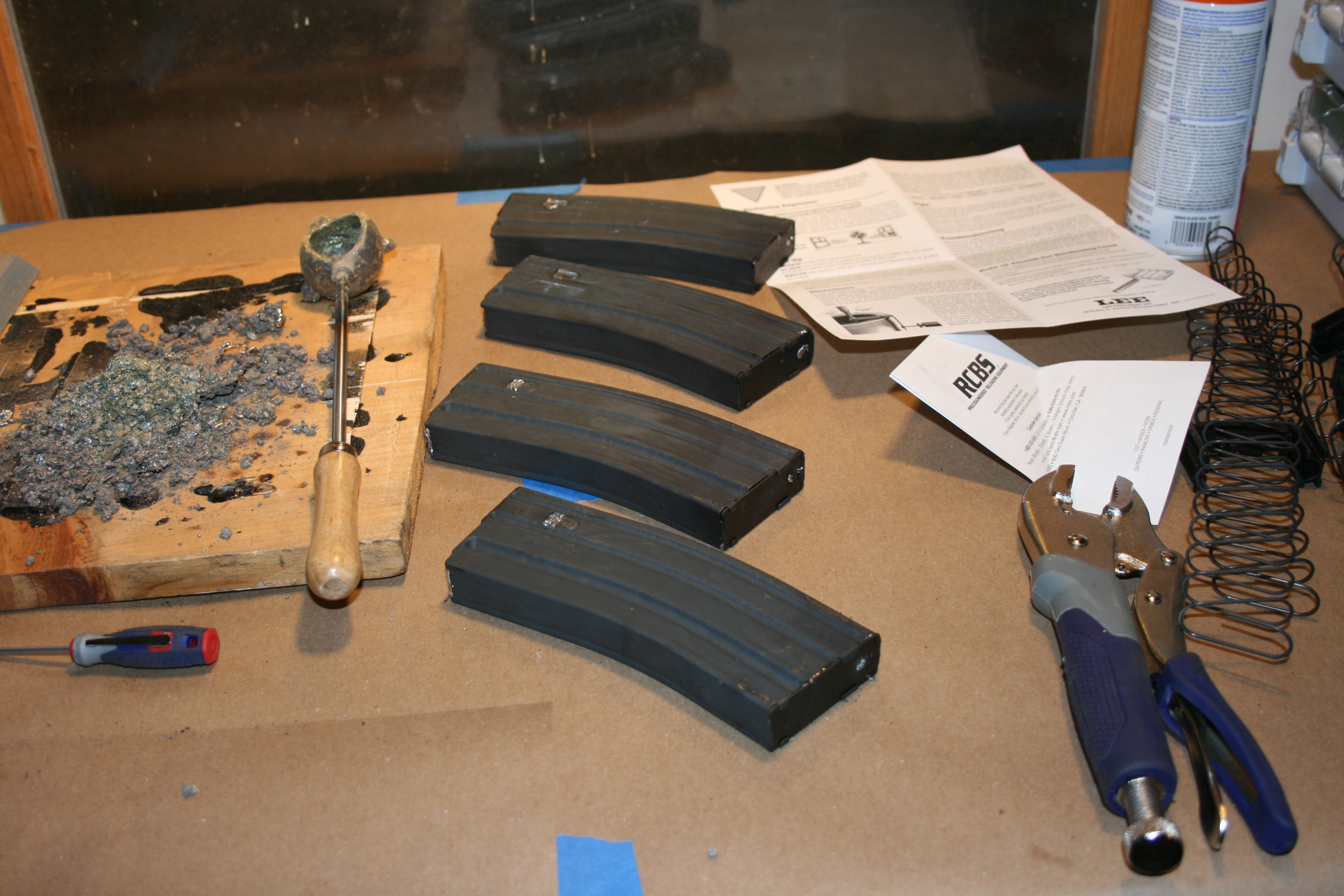
I ladled each magazine full of lead, then refilled the pot and let the melt heat up again while the magazine cooled. Finished product – a stack of magazines, each one weighing a touch over 5 pounds.

Finished Magazines.
The finished magazines, filled with lead. (Four of five, anyways.)

Same magazines spraypainted blaze orange because I’ll be running around wearing them at night through the middle of a college town.

Continue reading “GoRuck Team Weight”