Charmed, I’m Sure, Sez Tony Poe

IYI, Tony Poe is famous for tossin’ severed heads onto enemy locations and, on one occasion, when his superiors questioned his body counts (this was during the Vietnam War, which makes me figure he must have been paid on a per-kill, piecework basis because this is possibly the only time in that entire conflict where someone on the American side said ‘There’s no way you killed that many of the enemy’) he calmly provided hard evidence to verify his claims.

… By which I mean, of course, he mailed a bag of fuckin’ ears to the US Embassy in Vientiane. Possibly more than once. His personnel file must look like Ed Gein’s Rolodex.

This isn’t that grisly, of course, but – okay, fine, it’s a charm bracelet where the charms are human toenails. There’s some context for this, of course, but if you’re somehow the type who found this, read with bland, placid face about Tony Poe, Ed Gein joke, got to the toenails, and then decided that nope, no context makes that palatable, well… Probably don’t want to make the jump.

Continue reading “Charmed, I’m Sure, Sez Tony Poe”

Bookshelving: The Year in Reviewment

Why, yes, “The Year in Reviewment” would normally suggest a December date of publication. But the hurricanes down South sucked the lumber away from the Woodland Mills, so the last of the shelves didn’t arrive until early February. And then, well… Yeah. (N.b.: This is currently the first stage of book-shelving, wherein each book gets cataloged, measured, mylared and/or DDC categorized as appropriate, and placed on a shelf in some reasonable semblance of order. Then comes building the long-term shelves.)

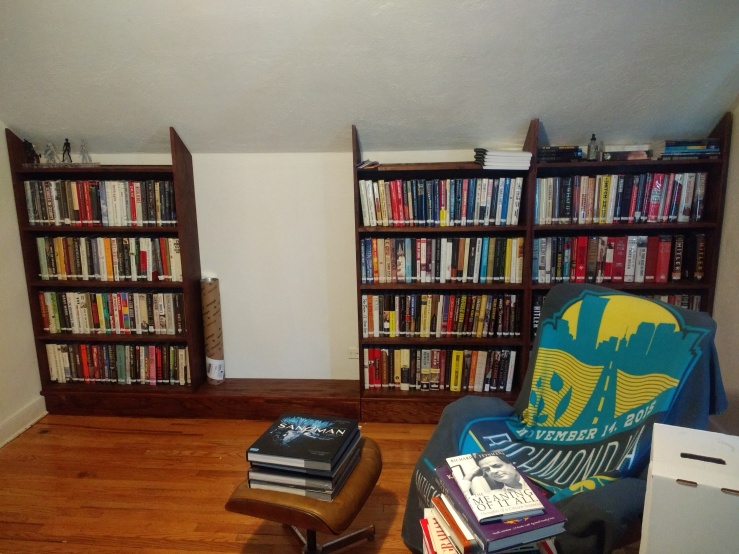
A quick tour of the library so far! First up, and first to be built, there are the under-eave shelves in the study. Yeah, the boards are cut for that fourth case, they just need to be, you know… attached to each other. And stained. (See, this, this right here, is why I relented and used pre-made shelves downstairs. Because I kinda wanted all of my books off of the floor within a decade of moving in, no joke.)

IMG_20180418_185741709_LL

Sized for standard hardcovers, made modular by the plinth underneath so they aren’t custom-cut for the baseboard (said modularity immediately nullified by angling the tops of the uprights to match the eaves), these have nonfiction, mostly biography and World War II history. 280 books shelved!

… out of 6,012, so ~4.66%.

escalated_quickly

Continue reading “Bookshelving: The Year in Reviewment”

A (Marginally) Better Use of My Time Than Watching Television; or, Never Skimp on Luxury –

– by which I don’t mean, ‘blow all your money on overpriced crap’. I mean, if you’re going to spend time and/or money on something for no other purpose than that you enjoy it, i.e., luxury, then you should spend as much time and money as you need to actually enjoy it (assuming, of course, that you can afford to). Stuff like, you know, gas, staple foods, office supplies, etc., I get them to accomplish a specific function. Assuming that they accomplish that function, the cheaper the better.

(Of course, this ignores the fact that things are not 100% necessity XOR luxury; my favorite brand of toothpaste (e.g., not that I actually have one) might be 90/10 necessity/luxury, whereas (depending on how much stock you put in studies that say writing longhand improves cognition) fountain pen ink would be 10/90 the other way around.)

Tl;dr, e.g., if you decide to ‘save’ and buy a $20 bottle of wine even though it’s not really all that good instead of your usual treat of a $50 bottle that you know you’d like, you didn’t save $30, you wasted $20.

… Which is all a long-winded way of saying that:

  • For the WH40k players, yes, I realize that conversions involving bits from five different companies (six, counting the eleven rare earth magnets of varying sizes), drilling and pinning, (minor) use of Green Stuff, and pre-assembly painting of almost all of the 23 individual pieces (not counting those magnets), per model, for a basic Troops choice is utterly ridiculous. (I also realize that grenades don’t have to be represented on the model.)
  • Of course, GW charging $80 for a squad of ten (10) metal (i.e., pretty much non-customizable) Sisters of Battle is also ridiculous. (I started this when 7th edition had recently been released, so by the time I finish it there’s a good chance that with 8th edition we’ll finally have nvrmnd we’ll probably be able to have the Emperor as our Warlord before we ever see plastic Sisters.)
  • Churchill himself adhered to a regimen of ‘2000 words and 200 bricks’ per day, or, to quote another great man, ‘the more complex the mind, the greater the need for the simplicity of play‘. (Because, y’know, if you’re going to implicitly compare yourself to one of the greatest wartime leaders ever, why not throw in one of the greatest starship captains ever, too?)
  • For everyone else, add up how much time you spend staring at the television or flipping through YouTube videos or your Facebook feed. And keep in mind that this is, like, one or two relaxing hours per week every other month at this point, at most.

So, all that out of the way, here’s Part 1 of “Converting (Mostly) Plastic Sisters of Battle in Way Too Many Ridiculously [Unnecessarily] Complicated Steps”:

Continue reading “A (Marginally) Better Use of My Time Than Watching Television; or, Never Skimp on Luxury –”

I Kinda Can’t Believe This Worked… – Bookshelf Design, Part 3

With the piles of ready-to-shelve books growing and a sufficiently large sample size ready for processing (~45.7% measured!) I decided to go ahead and see about making a smaller bookcase for underneath the window in the study while continuing the planning for the semi-built-in shelves in the other… okay, almost literally all of the other rooms.

1qxv61

Continue reading “I Kinda Can’t Believe This Worked… – Bookshelf Design, Part 3”

DIY: GORUCK Shoulder Strap

[There was to be something longer here but, honestly, this whole thing boils down to “I liked GORUCK’s old shoulder straps, I have GORUCK bags without shoulder straps, and GORUCK no longer sells the type of shoulder strap I like so I’ll make my own.” So.]

GORUCK used to make and sell the best shoulder strap I’ve ever seen – dual tri-glide adjust, just-right-width nylon webbing, and solid metal clips. They still sell a shoulder strap, but it has a section of sewn-on padding in the middle, and

  1. Said padding puts a rather high lower limit on the shortest length to which the strap can be adjusted, plus
  2. If you need padding on a cross-body shoulder strap, you should most likely be reëvaluating your load-carrying equipment choice(s).

(And, y’know, at $35 a strap, and given the number of GORUCK bags I have that could take a shoulder strap, less the number of shoulder straps I have already… why not DIY?)

Parts: Wasn’t too picky about the webbing or the tri-glides, but the snaps I wanted to be just right. My brother finally found these for me – 1 ½” Metal Snaphooks from Tom Bihn. (Cue sectarian strife over the mixing of Tom Bihn and GORUCK.) They’re a touch smaller, but otherwise appear identical to the snaps on my original GORUCK straps.

A few quick measurements gave 60.75″ for the total length of the webbing for the GORUCK strap, so I called it 5′ and cut and melted the edges of the nylon webbing. (No picture because one, it was blurry, and two, it’s exactly what it sounds like – five feet of loosely folded nylon webbing.)

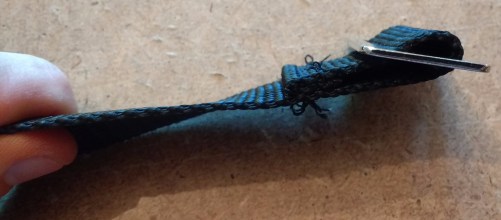
IMG_20170604_173221213
The first tri-glide attached. Note that my sewing machine had trouble going through three layers of heavy nylon webbing, so while the end-folds were machine-stitched, the tri-glide attachment was done by hand.
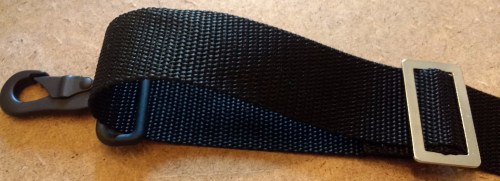
img_20170604_173246487.jpg
The first of the snaps attached with the rest of the strap threaded back through the tri-glide.
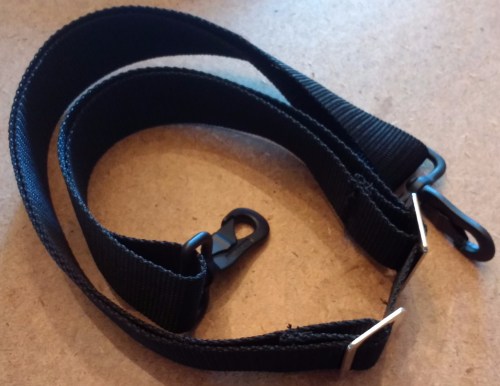
img_20170604_174011743.jpg
Finished strap, cinched down.

IDPA Template… template

Relevant Biographical Details:

  1. I make a large proportion of my purchases from Amazon.
  2. After extracting purchased items from their packaging, the cardboard shells (boxes) are chucked down the basement stairs, forming a drift there against the wall.
    1. Said drift now impedes progress down said stairs.
  3. IDPA targets are more fun to use than splatter targets or hand-drawn circles.
  4. I’ll pay… well, I’ll pay good money for guns and the ammo with which to… fuel? feed? supply? them, but paying for things which I’ll just shoot until there’s little left of them to be shot is… eh.

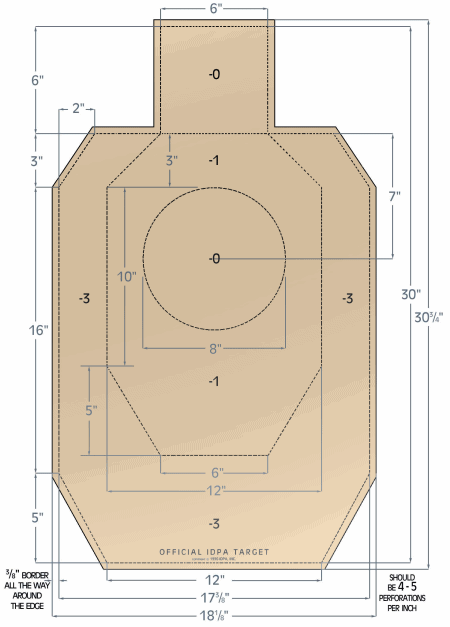
So. IDPA target specifications pulled from Google:

Continue reading “IDPA Template… template”

A Brief Setback – Bookshelf Design, Part 2

LibraryThing is awesome. It’s pretty much the only way my library can possibly be in any sort of order and the database export is the starting point for the cluster analysis shelving project. On top of that it’s a great community of tech people with a love for books, real actual physical printed books, which is a rare and valuable quality in the world today.

Unfortunately, in the process of cataloging and double-checking books as I boxed them up to take over to the new house, I discovered that some of the auto-generated physical dimensions are out-of-order (swapping height and length, length and thickness, etc.) or wrong.

Which means that I am now ~1% done with verifying and/or entering the dimensions of the books piled throughout the first floor.

So…

download (1)

GitHub – Bookshelf Design, Part 1.5

And it has begun…

https://github.com/dnorum/cluster_analysis

Technically, as can be seen from the commit history, it began at the end of November last year. But with books piled knee-deep around pretty much the entire periphery of my first floor, it needs to begin to get serious.

It still needs a bit more refactoring and updating to go from being a personal project, i.e. a hideously messy set of ad-hoc scripts racing to stumble and flop across the finish line before they achieve a critical mass at which point any bug ‘fix’ introduces k>1 new bugs resulting in an event horizon from beyond which useful results can no longer escape, to a ‘real’ project with an actual useful README and notes and well-structured directories and all of that that you can be reasonably sure you can run without accidentally rm-rfing (remreffing? rm -fr and rimfiring, maybe?) yourself in the foot.

And then I need to actually finish it.

But it’s getting there.

Overkill is Underrated – Bookshelf Design, Part 1

As part of moving to a new house I have the opportunity to (pending consultation with a structural engineer) actually shelve – rather than box – my entire library. Twenty-plus years of literary (and, well, some not-so-literary) acquisitions organized for the first time – the idea was thrilling. But it would require surmounting some serious practical difficulties.

(See the structural engineer mentioned above.)

According to LibraryThing’s wonderful stats page, my library at time of moving was roughly 4,377 volumes [‘roughly’ because it sometimes doesn’t fully capture multi-volume sets, pamphlets and magazines, etc.] weighing about 7,858 pounds and occupying (if they were to be somehow shelved) 725 linear feet. [Adding epsilon to account for my prolific use of post-it scrids.]

Obviously, my previous shelf-building strategies (to wit, building a case to fit whatever wall-space was available and then filling it up with whichever books were of an appropriate size; or piling up books of like size until I had a case’s worth and then building such a case) would be insufficient for this task.

A complication is that the library contains books of widely varying sizes. Lots of paperbacks, yes, and those are certainly straightforward to shelve, but also textbooks, square-format newspaper comic collections, textbooks, long-format comics collections (both large and small), graphic novels, trade paperbacks, hardcover books, etc. Given the number of bookcases I would be making, optimal usage of construction materials was also a consideration – textbook shelves would have to be constructed much more sturdily than paperback shelves; I wanted to avoid excess shelf depth for cost, weight, space, and dust-collection reasons; etc.

So I decided that this would be a good opportunity/excuse to try a ‘practical’ programming project – pull my LibraryThing collection info into a PostgreSQL database, scrub and format it, spit out the well-formed records to pass into an R script to run a K-means cluster analysis, plot the results as well as summary views before and after with GNUplot, pull it back into PostgreSQL to generate statistics for each cluster and add appropriate shelving tags to my LibraryThing database, and wrap as much as possible up in a bash script for simplicity’s sake.

(Before I began, I was well aware that after all of this I could very well end up with the classic “case for textbooks and tall books, two cases for trade paperbacks, the rest split between hardcovers and paperbacks” distribution, but in the first place it might very well not, and in the second, well, it’d be fun anyways.)

And…

Overkill is underrated.

GoRuck Team Weight

Each GoRuck challenge requires a team weight – 25# for the Challenge, 15# for the Light. Ideally awesome. For Light 002 with Cadre Devin, our weight was a lead-filled bulldog wearing a backpack filled with tiny, red-white-and-blue wrapped bricks. Time for a new team weight for the upcoming back-to-back Challenge-Light in Charlottesville.

Requirements:

1) Awesome.

2) Modular – able to be pared down for the Light without having to take a saw to it.

3) Portable – not just small enough to carry, but convenient to handle while buddy-carrying, crawling, running, etc. Also will need to be passed from person to person easily.

4) Awesome.

Solution:

Chest rig with magazines.
In addition to it costing a ton for the PMAGs and ammo, I don’t really want to carry around that much live ammo in a non-zombie scenario.

So – fill the magazines with lead.

After carefully figuring out the internal volume of a STANAG 4179 30-round magazine, I didn’t do any of that and bought a stack of metal 30-round magazines. (The cheapest and worst-rated I could find.)

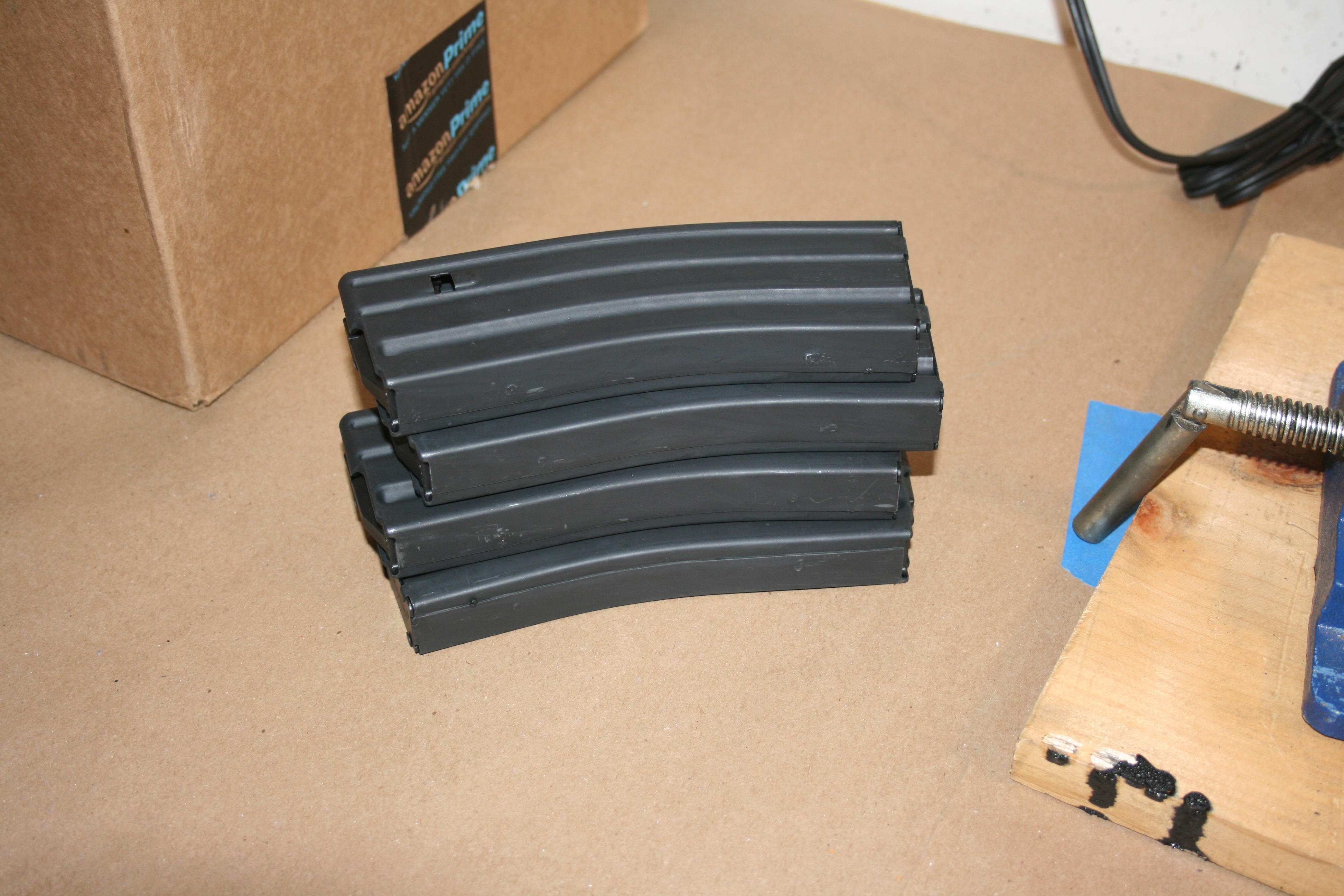
Stack of magazines.
Stack of magazines soon to be filled with lead. (One was already done as a test run.)

Now to fill them with lead. First, I stripped out the springs and followers.

Springs & Followers.
Springs and followers stripped out of magazines.

Then I melted some lead. Pieces of lead brick left over from previous weights went into the pot.

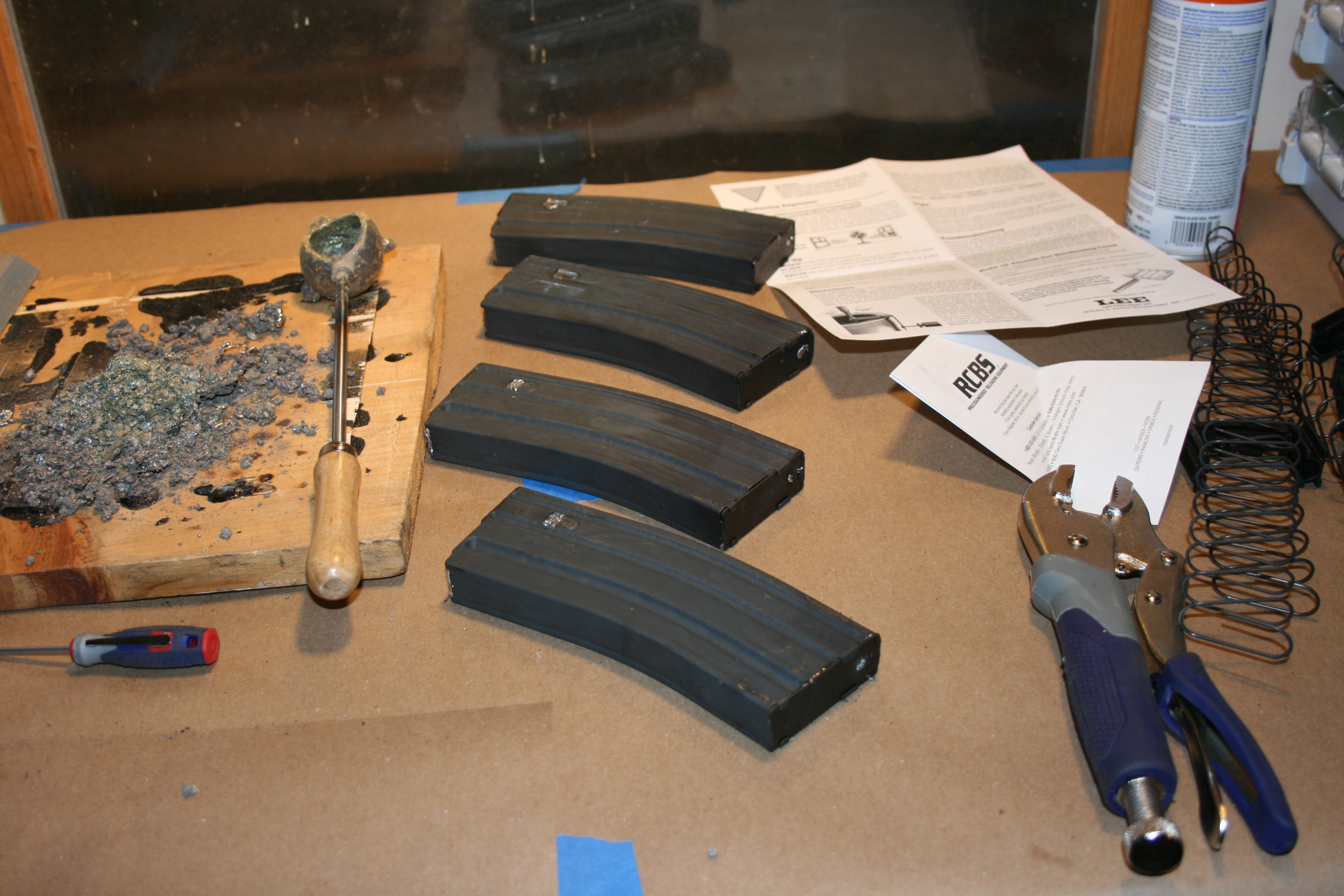
Workbench
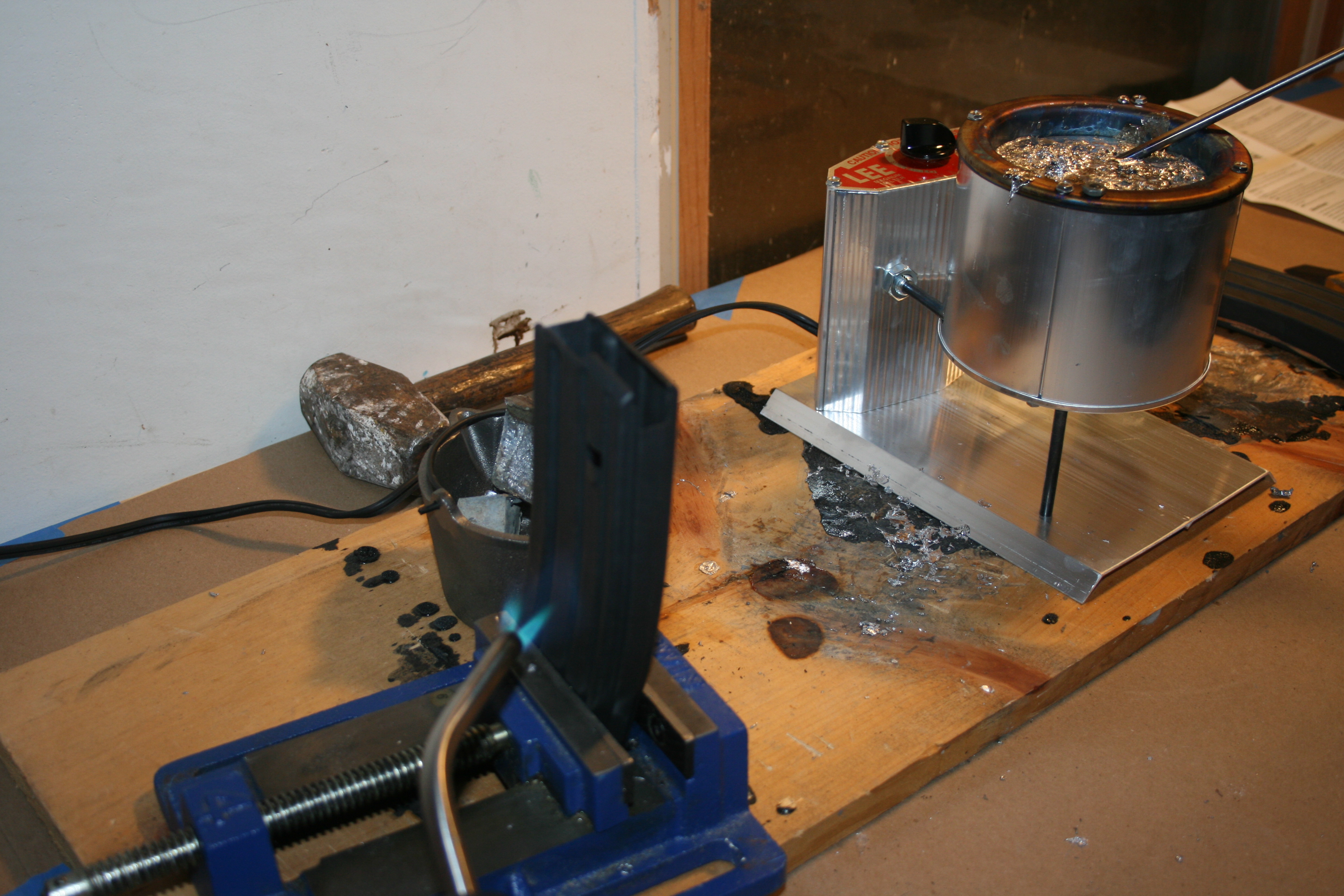
Vise for holding magazines while pouring, melting pot with lead, pot with more lead, hammer, cold chisel, and dipper.

Holding the magazine in a bench vise, I hit it with a blowtorch to preheat the metal.

Preheating.
Preheating the magazines with a blowtorch. Also burns off some of the coating.

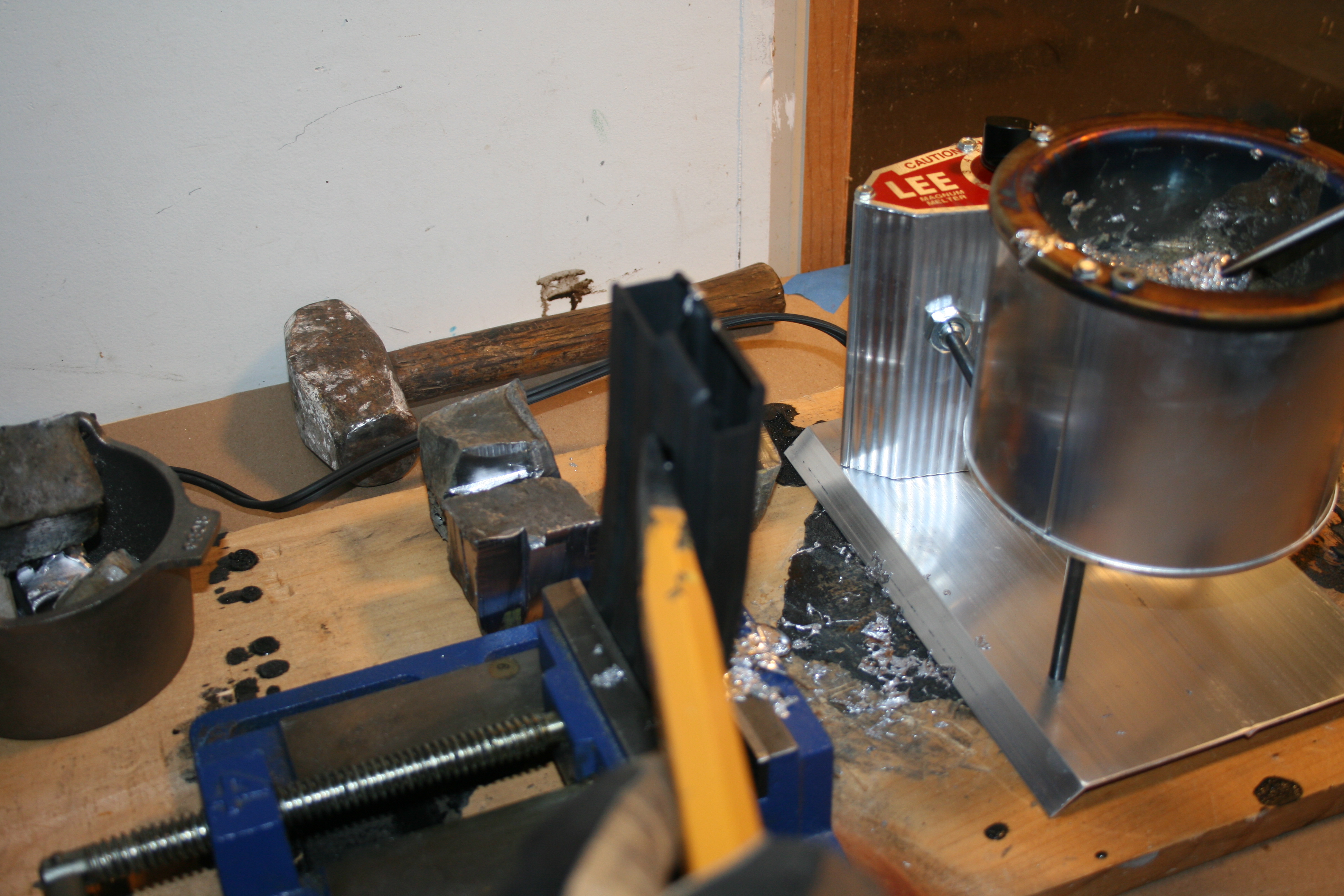
The magazines had holes in the base and for the magazine catch, so I held a flathead screwdriver against them as I poured that level. (The cold metal cooled the lead quickly enough to plug the holes. I still had some leaks, though, requiring re-melting and re-pouring.)

Mag Catch.
Covering the mag catch with a cold chisel. Still sprang a leak every now and then.

I ladled each magazine full of lead, then refilled the pot and let the melt heat up again while the magazine cooled. Finished product – a stack of magazines, each one weighing a touch over 5 pounds.

Finished Magazines.
The finished magazines, filled with lead. (Four of five, anyways.)

Same magazines spraypainted blaze orange because I’ll be running around wearing them at night through the middle of a college town.

Continue reading “GoRuck Team Weight”