Update 2016-05-13: If you’re interested in GORUCK Firearms Gear and missed out on the latest pre-order, my brother’s put together a quick tutorial about upgrading a regular rucksack into a Shooter-style Ruck:
https://www.reddit.com/r/Goruck/comments/4ipyk9/homemade_ruckshooter_ruck_upgrade/
Note – I wrote this up for my own reference from my scrawled notes the week after the FAD. If anything ended up misremembered or flat-out wrong, that’s on me.
No idea how long it’ll be up, but the Facebook page with pictures and such is here.
Introduction:
We started off hanging out in the parking lot for a few minutes as people trickled in – lots of GORUCK gear in evidence, obviously, and mostly young to younger-middle-aged males. An interesting contrast to the mostly older men and women showing up in equal numbers for the handgun class being put on by the range the same morning.
Snow started falling fairly heavily and, as fun as it would have been to see the vortex trails from the full firing line, I’d foregone a base layer of tights and was just in jeans… Fortunately, it let up by the time we came back outside after the briefing.
The Cadre called everyone into the clubhouse and introduced themselves (there had been a brief delay due to three or four traffic stops by State Police on the way over). Cadre Machine was leading the course, with Cadres Jesse and Logan assisting.
Everyone confirmed their name, age, occupation, GORUCK experience, and firearms experience. As you might expect, mostly male, mostly young – thirty plus ten minus five, a preponderance of police / EMT / firefighters / forensics scientists, a few techies, and most had done several GORUCK events.
There were several, though, who hadn’t done any GORUCK events, and several who hadn’t fired a gun before. Only a couple had serious experience with the AR platform (besides the Cadre, of course), though most had some pistol and general firearms experience.
Standard uniform was Arc’teryx jacket and cargo pants, supplemented with sweatshirts and morale patches. Apart from a couple of guys with chest rigs or battle belts and one guy running drop-leg, the tacticool-aid was at a minimum.
Scene set, we drove over to the club’s law enforcement range and got out our kit, set our stuff up underneath the shelter, and then joined Cadre Machine in classroom formation out on the range.
Cadre Machine: Basic Operations
- Finger straight until on-target, ready to shoot – if not, then out of the trigger guard and straight
- Thumb rides the safety – snap off when on target, snap on when done shooting
- Right hand has three (3) responsibilities: trigger, safety, magazine release
- Left hand has three (3) responsibilities: manipulating magazines, charging handle, bolt release
- Forward assist: Use after brass check to ensure round chambered; use to charge gun all quiet-like
- Check brass by pulling charging handle back to see brass through ejection port, then ride back and use forward assist to seat round
- If you don’t have a forward assist, don’t do brass checks
- Don’t use thumb on forward assist; hit with the heel of your palm
- Don’t baby the gun – hit the forward assist, let go of the charging handle and let the bolt slam closed, etc.
- Keep the dust cover closed as a matter of habit – whenever you manipulate the rifle while not shooting or after shooting, flip the dust cover closed
- ‘Rock’ the magazines in – index the front of the top of the magazine just inside the front of the magazine well, and then rock the magazine back towards you until it’s lined up (sometimes the tips of the bullets can inch forward underneath the feedlips and catch on the front of the magwell when you insert straight up – either catches or flips a round out and up into the guts of the gun)
- Same reason (as above) is why soldiers in Vietnam would knock magazines against their helmets before loading – make sure the rounds are lined up against the back of the magazine
(Note that these aren’t direct quotes from the Cadre, these are my notes on what they were teaching. So if it sounds weird that’s just how I remembered it for personal use, and if it’s flat out wrong then it’s because I got it wrong.)
Cadre Machine: Administrative Loading
- Two options – either lock the bolt to the rear, safe the gun, close the dust cover, and insert a magazine; or, safe the gun and insert a magazine (assuming dust cover already closed, bolt already forward)
- Either rack the charging handle or hit the bolt release (as applicable) as you come up to a shooting position from your ready position
Cadre Machine: Safing & Unloading
- On target, off safe / off target, on safe
- Whenever you’re done shooting a string, safe the gun
- To unload and make clear after shooting:
– (Safe rifle)
– Remove magazine
– Physical & visual inspection of magazine well
– Charge twice (2x)
– Pull charging handle back and inspect chamber, magazine well, extractor
– Drop bolt and close dust cover
Cadre Machine: Prone Position
- Load the gun standing
- Squat down
- Nondominant hand plants on the ground
- Kick the legs out back and to the sides, as wide as you can get them, heels down
- Shoulder the rifle – can use the magazine like a monopod if you desire
- To stand:
– Safe the gun
– Nondominant hand plants on the ground
– Nondominant knee up / nondominant foot plants on ground
– Kneeling position
– Unload and make clear from the kneeling position
– Stand
Drill: (25 Meter) Zeroing
Get down to prone as described above. Five (5) round strings, taking your time. Adjust sights after each string, moving to a new bull each time. Three strings, at most, should get you zeroed in for a tactical (CQB) class.
The cool kids who already had / trusted their zeros went over to one side of the range to stand and talk while the rest of us verified / dialed in our zeros. I’d boresighted the evening before heading north, but I wanted to be sure. (In retrospect, since the longest-range shooting we did was 25 meters at head-sized targets, I shouldn’t have been so OCD about it.)
We’d been asked to show up with zeroed rifles, but to be fair, some of the students hadn’t gotten their guns until a day or two before, and others were total beginners who’d never fired a gun before in their lives. (I’d boresighted the night before heading up to the hotel, so I just wanted to confirm everything.) That said, it didn’t take too long to get everything squared away.
(My embarrassing story here is that after inspecting my target and seeing my shots three-quarters of an inch to the right of the crosshairs [at 25 meters with an unmagnified EOTech from a 9″ barrel, in a CQB class using the “A4″ standard printer-paper target…], not only did I dial in an adjustment, but I mentally blanked and adjusted using 1/4″ @ 100 yds per click (default scope adjustment) instead of my EOTech’s 1/2″ @ 100 yards…
So the next string I shot was way over to the left.
I was dialing in my correction-to-the-overcorrection and getting my irons matched up [using a TAPCO chamber flag; note to self to bring coin] when Cadre Machine came by and asked to see my groups. When I pointed out the first one, he shook his head and asked me [paraphrasing] why the hell I’d adjusted anything.
My response that I had been 3/4” off at 25 meters sounded just as silly as you’d imagine the instant I said it. He said that that small of a deviation, it could be me or the gun.)
Cadre Machine: Firing Stance
- Five points of contact on the gun
1) Hand on grip
2) Off-hand on fore-end
3) Off-elbow / forearm tucked against magazine
4) Stock in shoulder
5) Cheek to stock (when firing; when scanning / moving, cheek off) - Finding shoulder-spot to seat stock:
– Blade your off-hand in front of your dominant eye
– Drop it to chest height
– Pull it in – that’s where you seat the stock - Make sure to tuck your elbows in – no chicken wings
- Both eyes open (we were all using irons or red dots / reflex sights)
- Ready position: standing up, hands facing palm down slightly raised above your waist, gun held in the dominant hand horizontal to the ground
- Likely not operating in a free-fire environment, i.e. probably not walking around with a slung rifle at all times; simulates retrieving rifle from trunk / rack / case / etc.
Maybe this is common knowledge, but it was new to me – when using a double-mag setup (two (2) magazines coupled together) the one on the right is the primary, loaded first. Cadre Machine’s shot sheet / class outline originally listed a demonstration of how to make a solevet, but that ended up being cut for more shooting drills.
Cadre Logan on the other hand, was of the opinion that coupled mags were “no bueno”. Ended up being too heavy for patrol use, what with 2×30 rounds of ammo added to the gun. In fact, he preferred using a 20-round magazine in the gun, with 30s in his rig.
I tried a double mag setup for the first couple of drills, and then switched to a pair of singles for the rest of the day. It seems intellectually like it would shave a fraction of a second off the reload time (off-hand doesn’t have to go to the waist / chest for the next magazine) but would require a bit more timing / coordination (grab the mag, then release, then pull it out and shift to the backup mag; versus drop the mag while grabbing a mag, insert the mag). And it would then require a different reload motion for the next mag.
I’ll need to practice way more before I have a non-bullshit opinion of my own on it.
Cadre Logan: Gear
- As flat as possible – e.g., single-stack shingles instead of double
- Keep weight off your legs / no drop-leg gear
Cadre Logan / Cadre Machine: Stance
- “Fighting stance”
- Nondominant foot takes a slight step forward
- Feet about shoulder-width wide, maybe a touch wider
- Feet pointing forwards towards the target
- Slight bend forward in the waist
Cadre Machine: Loading
- Push: What it sounds like – push the magazine up into the mag well
- Click: Hear / feel the magazine catch click
- Pull: Before you let go of the magazine, give it a pull to make sure it’s fully seated
“This is the modern-day Excalibur. The rifle is your sword.”
“Out there is the problem. In your hands is the solution”
– Cadre Garret Machine
We split into three groups, roughly 8-10 people in each group paired off with battle buddies – initially for coordinating targets, later on for two-person drills. Each group had a Cadre with them, calling people up to the firing line, activating shooters, giving instructions and corrections as appropriate.
People could switch groups as they wanted to work with different Cadre throughout the day. Each one had a very different style of teaching and correction, so there was a nice variety.
After each drill, Cadre Machine would call all of us to classroom and go over what we’d just done, emphasizing the takeaway points. Then he’d give us the mag loadings for the next drill – we’d load up and return to classroom where he’d introduce, explain, and demonstrate the next exercise, stressing the goal of the drill and how it fit into the larger philosophy of the class, which was counterterrorist / active threat response.
In that note, we were drilled into the habit of shouting “Threat!” whenever we engaged. Cadre Machine explained that it was a succinct way of getting across that the bad guy was over there and you were the good guy. Makes sense.
Drill: (10 Meter) x2-x3 Rhythm Drill
First magazine loaded with 12 rds., second magazine loaded with 15 rds. For the first magazine, fire two-shot strings. Reload. For the second magazine, fire three-shot strings, trying to keep an even rhythm – bang, bang, bang. Not bang-bang… bang, etc.
Drill: (12 Meter) x3-x4 Rhythm Drill
Load 15+16 in two mags. (First magazine 15, second 16.) Three-shot strings, reload, four-shot strings. Trying to keep an even rhythm.
Cadre Machine: Rhythm
- Go fast – we’re at point blank range or closer on these drills
- Keep a good rhythm, cadence going – don’t pause between shots or snapfire
- Rate of fire is proportional to distance to target, size of target, and your own ability to fire accurately / quickly
- 3-5 shots per string = roughly how many you can get off on one target before a second threat responds effectively
- < 3 and you’re risking them not going down
- > 5 and you’re risking leaving yourself open and vulnerable
Cadre Machine stressed that the class was less about marksmanship – we could go out to the range on our own and practice getting tighter and tighter groups – than about combat strategy. Also, that in a traditional training environment, such as in the armed forces, we’d be building up to all of these. Maybe firing 20 rounds total the first day.
Here, they were introducing us to a big helping of the concepts and the drills that went with them, so that we could practice them later on our own. That’s why we were going to be getting to do the ‘cool guy’ stuff so (relatively) quickly.
Not, Cadre Jesse added, that we’d be doing it, you know, well. But we were still getting to do it way sooner than we would learning it ‘for real’.
Drill: (15 Meter) x4-x5 Rhythm Drill
Load 16+20. Four-shot strings, reload, five-shot strings. Keep an even rhythm.
Cadre Logan: Stance
- Feet in about a 2/3 front stance (how I would describe his demonstration)
- Knees bent
- Think recoil management
- Upper body steady; think of competition shooters and how their upper bodies are like turrets
- Eliminate extraneous motion
Drill: (25-15 Meter) Walkup Drill
Load 5+5 (two runthroughs). Starting at the 25 meter line, walk forwards. At the 15 meter line the Cadre activates you – a slap on the back or shouting “Threat!”. You shout “Threat!” as you step forward (NOT backward) into a firing position and fire a string of 5 rounds at the target.
The idea with the above drill, as Cadre Machine explained, is that we’re walking to investigate something suspicious -something that might fit a terrorist’s M.O. – and when we see something that confirms it, we activate.
He went over three levels of observation, building on each other. The first is something simply out of place – a guy wearing a big jacket when it’s warm out, someone walking the wrong way in a crowd, etc.
The second is something actively suspicious. Someone wrapping something up quickly in duct tape in a trunk (I may need to rethink my last-minute Challenge preparations…), someone leaving a pressure-cooker shaped backpack on the ground and walking away, etc.
Lastly is a threat, i.e. something that should be destroyed. Guy running at someone with a hatchet, guy shooting with an AK-47, etc. Only charge the rifle and chamber a round when you’re at the threat/destroy stage and it’s go time.
Cadre Machine: Malfunctions
- Number 0 malfunction, most common by far, is that people forget to take the safety off
- #1 Malfunction is the magazine isn’t seated fully
- #2 Malfunction is a short-stroked or ridden charging handle
- #3 Malfunction is a bad primer
- Slap-rack fixes them all:
– Slap the magazine into the magazine well (fixes #1)
– Rack the bolt (fixes #2, #3) - Fix for #0 is to know your weapon
Cadre Logan: Malfunctions
- Call it a double feed, stovepipe, whatever – shit’s where it’s not supposed to be
- RIP the mag out – may send rounds flying, but that’s okay
- Charge the gun twice
- Replace the magazine and charge again
- “Mortar” clearance:
– Rip the mag out, lock the bolt to the rear
– Holding the gun angled with magazine well and ejection port pointing roughly downwards, shake it vigorously
– If you can, pound the buttstock into your shoe (hardest thing around, usually) to shake stuff out
– Remember, don’t baby the gun
– Replace magazine and charge as usual
Drill: (25-15 Meter) Sprint Drill
(We didn’t do this because of the snow and ice on the ground – someone slipping with a slung gun, no bueno. Since we didn’t do this, there wasn’t a standard starting condition or magazine loadout mentioned.) Starting at the 25 meter line, sprint forward to the 15 meter line and stabilize before engaging the target(s).
Cadre Machine then went over the reaction sequence – how we react to surprises, threats, how that affects training / actions. Fear – something you can be ready for, you know that it’s coming. Getting ready to go into a house after an armed adversary, for example.
Fright is when something happens that’s unexpected – bomb going off nearby. Purely physiological reaction – you lower your body, feet shift wider, hands come up. Natural response. Rather than fight it, just adapt it as a basis for your shooting stance, rather than something that’s twice as complicated and only a few percent ‘better’, if that.
(Note – I’m writing the drills up more as part of the narrative from here on, because honestly, if you’re doing live-fire partner drills involving shoving, cars, etc., you really shouldn’t be using Internet anything as a resource. It was awesome fun, though.)
Drill: (15 Meter) Push Drill
10 rounds, one (1) magazine. While shooting at the target, the Cadre would give us a push every now and then. (How strong varied based on Cadre and individual – there was one guy who, I think, had years and years of police rifle training and was a range officer. Cadre Machine, among other shoves, kicked him in the back of the knee a time or two. The beginners, on the other hand, got more of a gentle nudge.)
As soon as you felt the push, you safed and lowered the rifle. You went with the push, reestablished your footing, and then brought the rifle back up and continued firing.
Drill: (15 Meter) Buddy Drill
5+5. (Here’s where we really started working with our battle buddies, under close Cadre supervision, of course.) Start in the ready position, back to back with your partner, target directly to your left or right. The Cadre would tap one of us on the shoulder.
The person tapped yelled “Threat!”, echoed by their partner. Both would turn toward the target and engage with one string of fire. We repeated facing the opposite direction so that we practiced turning to both the left and the right.
Drill: (15 Meter) Car Carry
5+5. Oh hells yeah, this was awesome. This drill was introduced with three cars backing onto the range, lining up spaced out at the 15 meter line. Windows down, doors unlocked. Guns started staged in the backseat, we started sitting in the front seat with our battle buddies.
When the Cadre yelled “Threat!”, we would exit the car and retrieve the rifles from the backseat, leaving the doors open. We’d take up firing positions just past the rear of the vehicle (so Cadre could control both of us) and engage the target with a string of fire. Rifles weren’t charged until we were in our firing positions, so that there was never an instance of a chambered gun (safed or no) being pointed anywhere other than downrange.
Cadre Machine: Kneeling
- 3 points of contact:
– Nondominant foot (nondominant knee up)
– Dominant knee
– Dominant foot (up on the ball, toes underneath, to move quickly if needed) - Foot-foot-knee make a sort of triangle (kinda like a katakana ‘so‘ with the dot moved up a bit, or a 45-45-90 triangle with the hypotenuse towards the target); not too wide, not too narrow; not too long, not too short – well- balanced all around – hell, just watch TrainWithTheIDF on YouTube
- You can use the raised knee for support:
– Knee and elbow are both round, so right on top won’t work – unstable
– Put the elbow just to the inside of the knee
– Press out with the elbow, in with the knee
Drill: (15 Meter) Stand-Kneel-Shoot
15+15. First time through, shoot a fireset of 5 rounds standing, then kneel. Another 5-round string, stand up, and a third 5-round string. Second time through, reverse the order so that you go kneeling-standing-kneeling.
Cadre Machine: U-Transition
- Going from target-to-target, you don’t want to sweep the muzzle laterally
- Could be no-shoots in-between, or you could overshoot and swing past the second target
- Use the U-transition: down, over, and up
- Remember to safe the gun when off target (get used to snapping the safety off and on)
Drill: (15 Meter) U-Transition
9+9. Choose two targets with a small separation between them (don’t cross the streams with other shooters on the line). On the “Threat!” activation, shoot one string of 3 rounds at the first target, U-transition to the second, 3-round string, u-transition back to the first, another 3-round string. (Repeated twice.)
Drill: (15 Meter) Failure to Neutralize / Finish After Neutralizing
4+4. Three (3) rounds to the center of mass, one (1) round to the head. Depending on interpretation, can either shoot at the head of a standing target (first string failed to stop adversary) or can shoot at the pelvic area of a standing target (not a dickshot; scenario is adversary has been dropped but still poses a threat). (Repeated twice.)
Cadre Machine went over this last exercise a bit, breaking down the real-world situation. It takes about 2 seconds to bring the gun up and make it ready, on target, etc. Actually firing the first string takes maybe 0.2, 0.3 seconds (eventually), followed by another second to transition to the head shot.
The goal is to eventually get the whole drill down to 4 seconds or less, which feels like forever sitting looking at your watch, but when you’re manipulating a rifle, aiming, managing recoil, transitioning, firing… (At least for me.)
Here was where some more of the underlying philosophy of the class came into play – approaching this from a counterterrorism point of view meant that, while we were still shooting to stop a threat, that threat wasn’t stopped until it was dead, period. The earlier GORUCK FAD for pistol had the same type of failure-to-neutralize drill, although the headshot was strictly against a standing target.
Cadre Machine emphasized the difference between a criminal – money/profit motivated – and a terrorist – blood motivated. And in order to defeat them, he said, you had to be more savage than the savage – yet still in control. He said that, paraphrasing due to memory, a terrorist is not a person – they are an entity that looks like a person, in the shape of a person, but that fortunately for us they also have the anatomy of a person and respond in a similar way to gunshots.
This carried over to the next drill, in the context of encountering someone holding a hostage. The person responsible for taking that shot, he emphasized, is you – the person there at that moment with the means to do it. The movie version where you throw down your gun and surrender, or don’t take the shot – yeah, no.
(Here I had a bit of a derp moment, asking about firing positions. The drill had us leaving the guns on the firing line as we sprinted to the cars and back, and I asked about alternate firing positions other than standing. For whatever reason I had blanked on the ‘real-life’ context, where we’d be sprinting up, heart pounding, with the gun, and thought, well, if I’m already more than halfway to the ground to pick up the gun, why not shoot prone?
Of course, the sprinting and picking up the gun here were because, for obvious safety reasons, we weren’t sprinting on snow and ice with rifles. The gun wasn’t actually starting on the ground in the real-life situation the drill was mimicking.)
Drill: (15 Meter) Headshot
3 rounds in one mag. With the mag in the gun, no round chambered, leave the gun on the firing line pointed downrange. Sprint 20, 25 meters back and turn around, sprinting back. Pick up the gun, assume a firing stance, chamber a round, and make a single headshot.
Clear the gun, put the ejected round back in the mag, mag back in the gun, and repeat.
Drill: (15 Meter) Reloading Transition
5+5. Starting back to back with your battle buddy. On the call, turn and fire a string of 5 rounds at the target standing. As soon as you run dry, kneel and reload, then fire another string. Repeat starting on the other side.
We also did this drill staying standing both times, as well as moving forward and to the side as we reloaded.
Drill: (15 Meter) Alternating Reloading
5+5. We started back to back with our battle buddies. The Cadre would activate one of us who would repeat the call of “Threat!” and turn and engage. The buddy would echo the call and turn but not engage. When the first buddy ran dry, they would shout “Jam!” and transition to the next stance while reloading.
When they heard “Jam!”, the second buddy would begin firing. When they ran dry, they’d shout “Jam!”, by which point the first buddy would have reloaded and be ready to resume fire. Back and forth for two magazines each. Did it standing-standing, standing-kneeling, etc.
At the end of the day, once we’d cleaned all of our stuff up and stowed it in our cars (save for rifles for the class picture) we had one last classroom for a group AAR, where people pointed out what they’d liked about the day, what they hadn’t, suggestions for next time, etc.
All in all it was an amazing day, and well worth it.
Obligatory geardo shot:
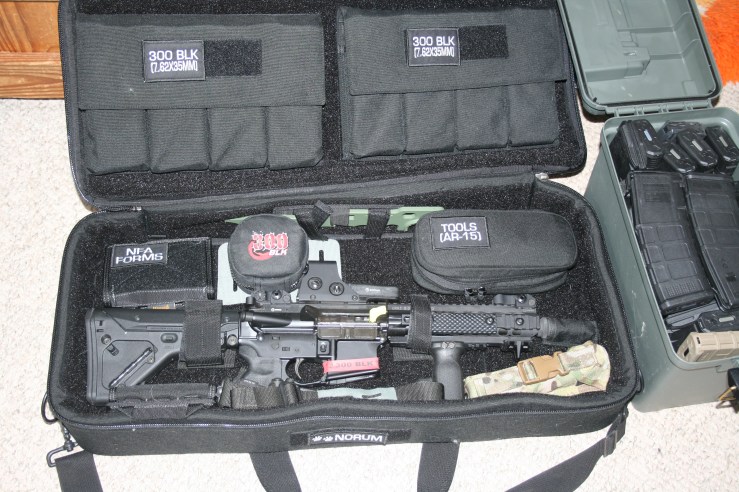
(The case to the right is filled with random magazines, mostly 30-round PMags, brought because I compulsively overprepare. [In the same vein, note the multiple labels inside the rifle case…] It turned out that there were several New Yorkers there though, and it felt good to be able to have enough magazines to share. The mag band around the lower is because my brother and I took the class together – he was shooting 5.56, I was shooting 300, and never the twain should mix…)
The GORUCK rifle case fit my SBR perfectly, without having to break it down. I ran a 9″ AAC upper with an 762SDN-6 can, Magpul RVG and XTM handstop, Troy BUIS (never used), EOTech 512, and a no-name lower with a Magpul MOE K-Grip and UBR stock. Worked A-OK for the class (the only malfunction I had was from my loading a magazine improperly), but I found out a few things afterwards:
- It’s heavy. Like, seriously heavy. I don’t plan on lugging it long distances, and it’s fairly well balanced, but the UBR, EOTech, etc. made the weight noticeable.
- The angle of the K-Grip was fine, but especially with gloves on, I felt like I could have had a tackier grip.
- Push-button sling swivels were hard to manipulate sometimes. Probably was just the gloves, though. I never really had any problems with them – just kinda annoying from time to time.
- We did a lot of bolt manipulation, which was quite awkward.
So, I’ve ordered an MOE K2 Plus grip – rubber overmolding should help with the grip – and a Vltor BCM Gunfighter charging handle with large latch and a Magpul BAD lever, which ought to help out with the bolt manipulations.
Oh, and right – GORUCK FAD. There may not be many dates listed; as of right now they delist the classes that have filled up. They fill up quick, and for good reason.


Thanks for this excellent and super-helpful article! I’ve signed up for the Pistol and AR FAD in July (no firearms experience) – can’t wait!
LikeLike